
For many automobile stylists and designers, the scale model of their latest design is often the first time their vision results in a tangible product that can be held, examined and refined. The model is then often used to guage interest from other designers, consumers and potential investors in the project. Usually, the model is just a stepping stone to the next iteration for the project. As the final design becomes more and more changed, the original model's typical fate is to become at best an interesting paperweight and at worst cannibalized and discarded in favor of other projects.
What's so unusual about Alex Tremulis' sports car model, is that it served as design inspiration for several notable car companies spanning several years. Starting with Tucker Corporation and ending at Kaiser-Frazer, it took on a life of its own between its corporate duties and almost (or maybe it did) became a reality in the process. The following photographs and articles document the life and times of this well-travelled sports car model that incorporated state-of-the-art concepts in streamlining and aerodynamics.
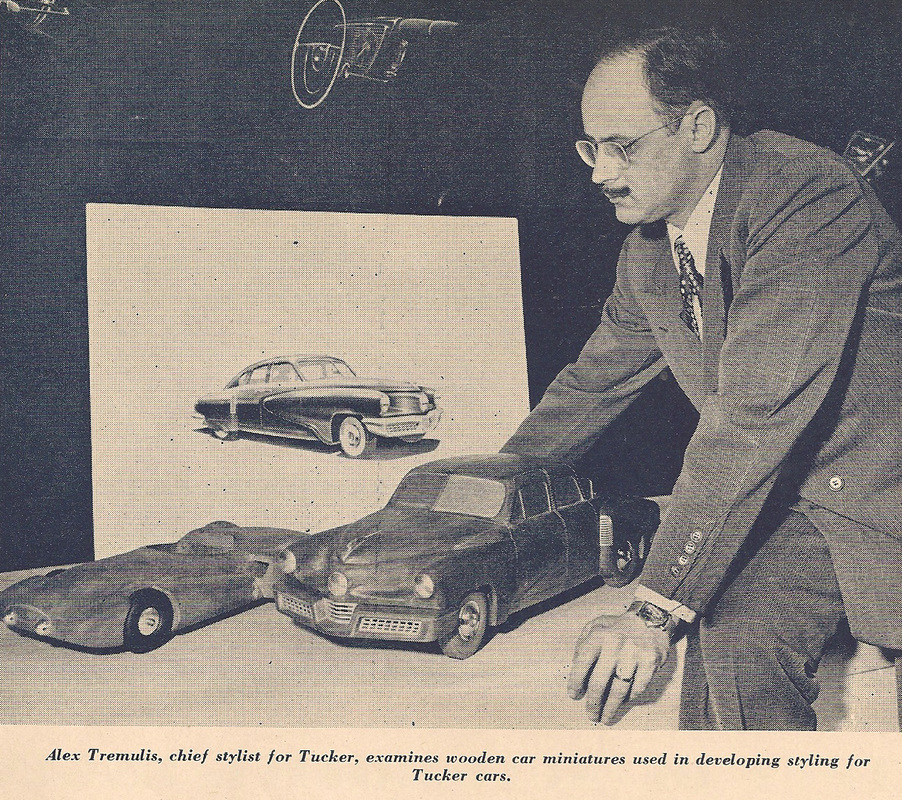
The concept for the sports car started at Tucker. Below, Alex Tremulis and the models of both the production Tucker '48 and the sports car appeared in the May, 1948 Tucker Topics, the dealer periodical distributed by the Tucker Corporation. The model appears to be either still under construction or just prior to getting painted.
What's so unusual about Alex Tremulis' sports car model, is that it served as design inspiration for several notable car companies spanning several years. Starting with Tucker Corporation and ending at Kaiser-Frazer, it took on a life of its own between its corporate duties and almost (or maybe it did) became a reality in the process. The following photographs and articles document the life and times of this well-travelled sports car model that incorporated state-of-the-art concepts in streamlining and aerodynamics.
The concept for the sports car started at Tucker. Below, Alex Tremulis and the models of both the production Tucker '48 and the sports car appeared in the May, 1948 Tucker Topics, the dealer periodical distributed by the Tucker Corporation. The model appears to be either still under construction or just prior to getting painted.
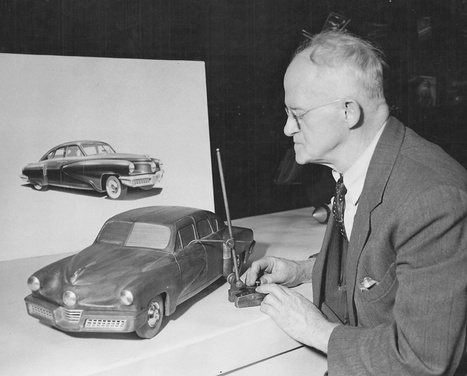
Cliff Knoble, Advertising Manager, during the same photo shoot by "Chicago Photographers".
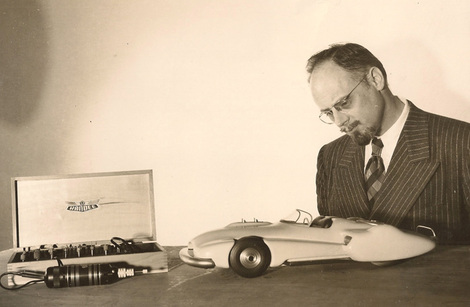
c.1949: Posed with his model-making tools and the Tucker sports car, Alex Tremulis examines what looks to be the completed and finely detailed scale model.
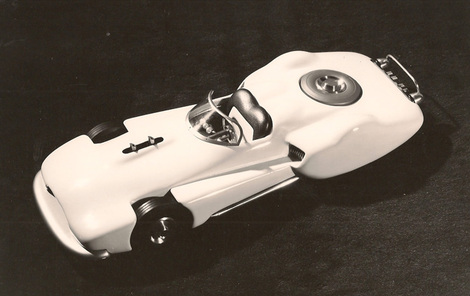
The exposed top of the front wheels in the design was most probably due to comments from Tremulis' long-time friend, Ab Jenkins, who thought you had to see how the tread was wearing on the tires and how the suspension was handling the roadway - especially important for racing.
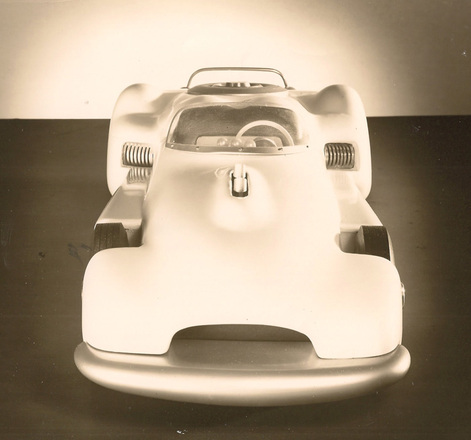
The menacing front view shows proportions that were still far ahead of its time...
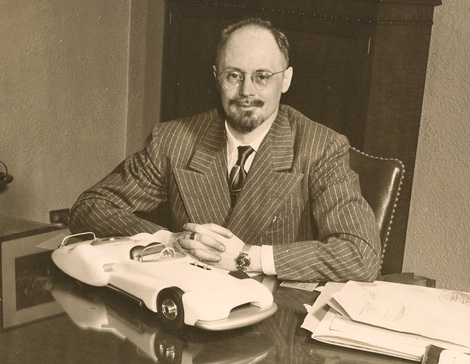
c.1949: The confident creator of the next American sports car looks ready for all takers in the project.
The photos from this phtoshoot then appear in the April 23, 1949 Sunday Times with a description of the proposed sports car. A guaranteed 125 miles per hour from the car at this point!
Even with the standard production Tucker '48 doomed at this point, Tremulis still stayed on with Tucker until the very end. So this new endeavor for the model was most probably a side venture.
The photos from this phtoshoot then appear in the April 23, 1949 Sunday Times with a description of the proposed sports car. A guaranteed 125 miles per hour from the car at this point!
Even with the standard production Tucker '48 doomed at this point, Tremulis still stayed on with Tucker until the very end. So this new endeavor for the model was most probably a side venture.
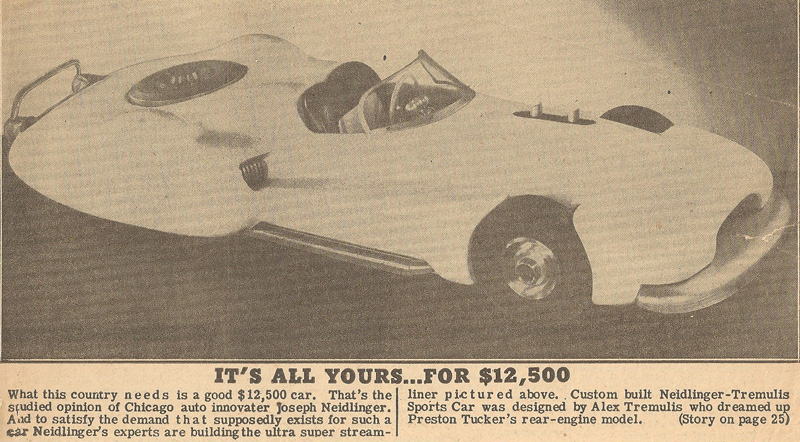
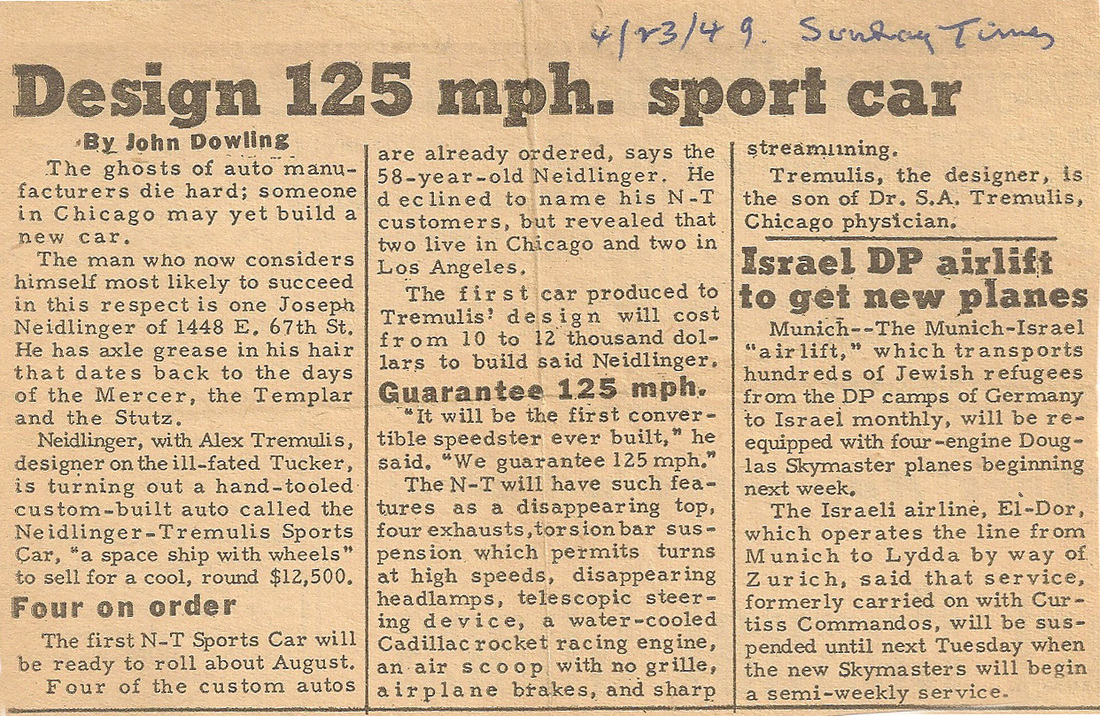
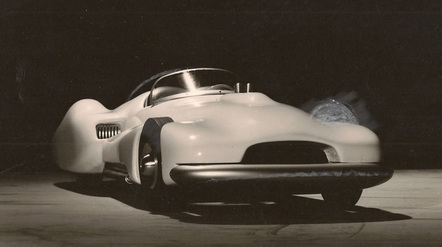
It's still unknown if any of the four orders for the car ever materialized, but as time progressed, so did Tremulis' ideas to improve the design. With no Photoshop available, Tremulis took paint and ink directly to the studio photos in order to create the enclosed fenders.
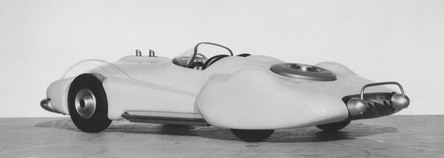
Tremulis' pencil lines attempt to redefine the front fenders.
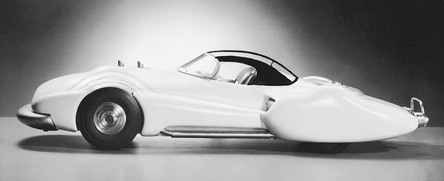
The removeable hardtop is painted onto the side view photo and the front fenders are pencilled in.
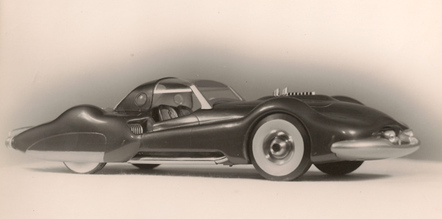
c.1951: The final result with the newly built removeable hardtop and enclosed front fender, including a fresh new paint job.
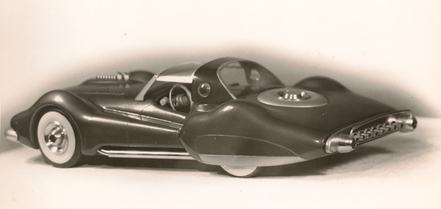
And just that simple, a new model is created. By this time, Alex Tremulis had joined Kaiser-Frazer and he took it upon himself to become the advanced styling studio.
By April 1951, exactly three years since its Tucker debut, the freshened-up model makes its first public debut in the Kaiser-Frazer newsletter.
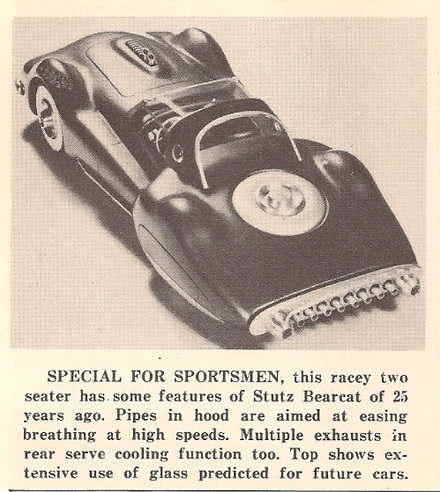
April 27, 1951 description within the Kaiser-Frazer newsletter.
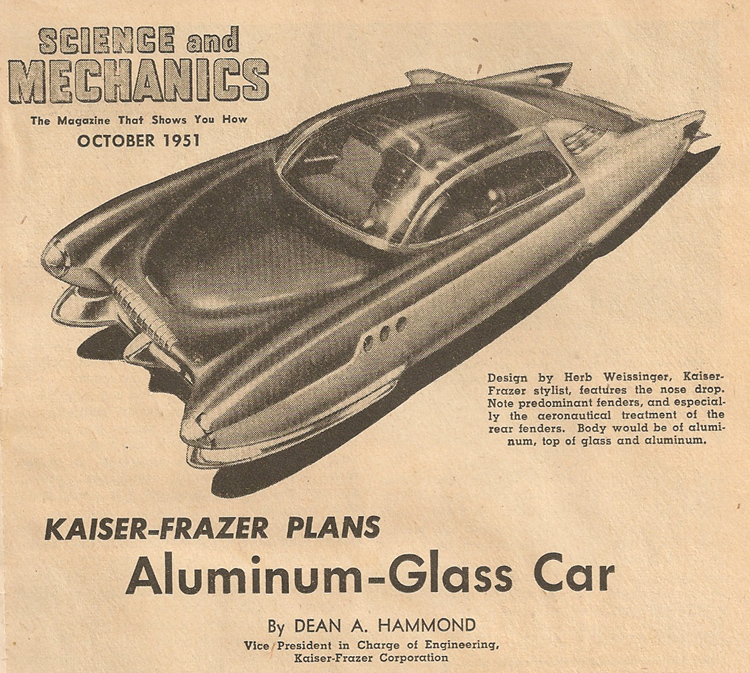
Below: October, 1951, Science and Mechanics picked up on K-F's future plans and ran the following photos and description of the model. By now, the car's top speed had increased to over 135mph.
Below: October, 1951, Science and Mechanics picked up on K-F's future plans and ran the following photos and description of the model. By now, the car's top speed had increased to over 135mph.
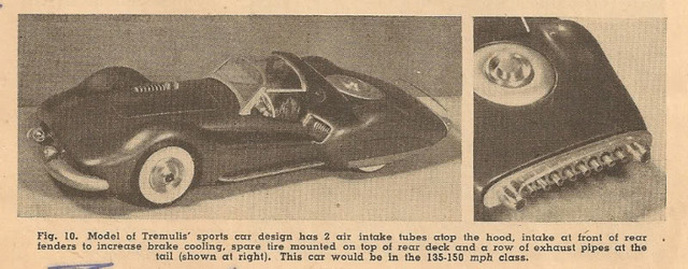
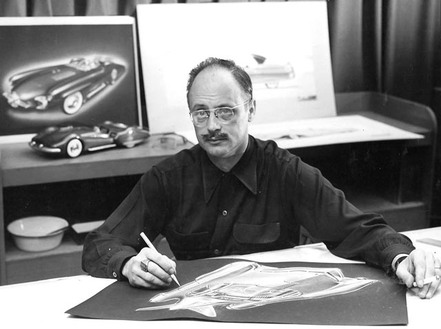
c.1951: Alex Tremulis at work in his Kaiser-Frazer office in the Willow Run plant. The Tucker-Tremulis-Neidlinger-Kaiser-Frazer sports car model sits proudly on his credenza.
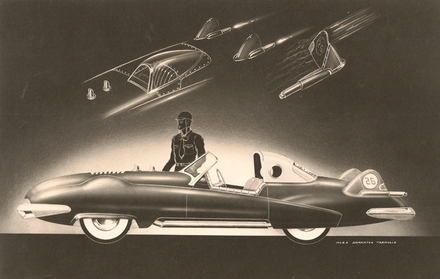
c.1952: With Kaiser-Frazer's future in serious doubt, Tremulis is given free-reign to push the limits of his imagination. As part of his 1952 "Styling Unlimited" speech to the Society of Automotive Engineers (SAE), his car, now a sports-competition design, incorporates air brakes on the rear fender fins and a fighter plane cockpit fairing for improved streamlining. It's presented as one possible future means to actively use aerodynamics for improved performance and handling.
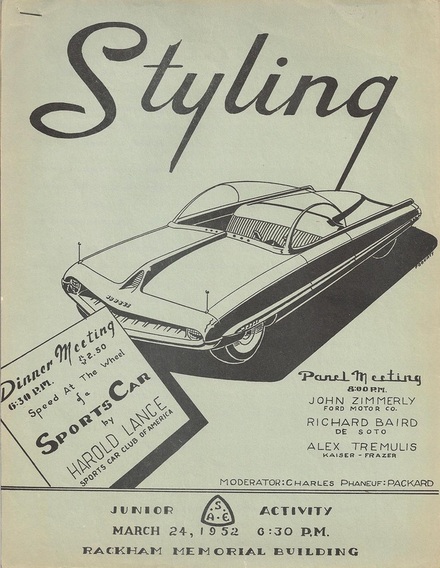
It would be at this meeting that Tremulis would also introduce his concept for a gyro-stabilized two-wheeler that eventually would become the Gyronaut X-1 over a decade later. It was also at this meeting where Ford would snatch up Tremulis to help out with their own advanced concepts, a spot Tremulis cherished for the next 11 years. Of course, after designing for so many failed car companies (Cord-Auburn-Duesenberg, American Bantam, Briggs Design, Custom Motors, Crosley, Tucker, and Kaiser-Frazer), when he walked into the Ford plant, his first thought was that here is a company that even he can't bring down. As he put it: "I’ve gone down on more sinking ships than there are ships left." Each of the concepts that this model employed would find their way into many of Ford's Autorama show cars that Tremulis would eventually design.
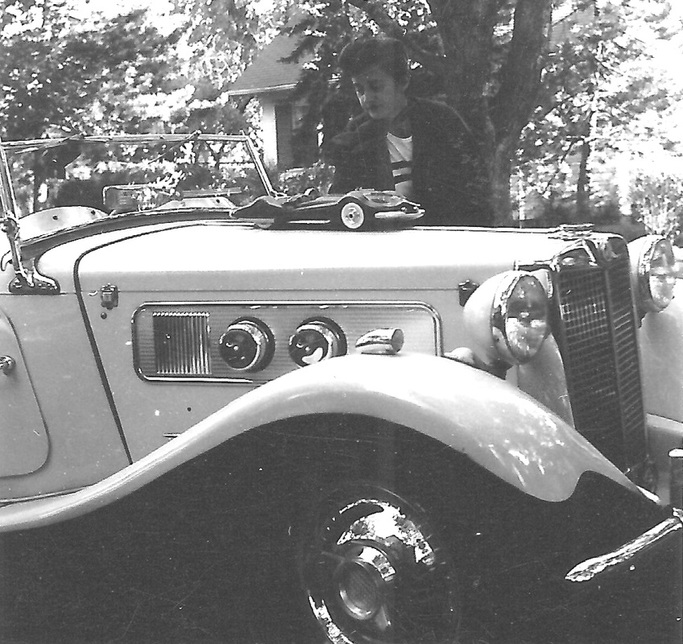
Chrissie Tremulis, Alex's wife, looks over the model on the hood (bonnet) of his highly modified MG. Never one to leave well-enough alone, whether it was his scale models or his (or Chrissie's) personal car, they all were subjected to Alex's design and performance improvements. With his MG, he tried to stay competitive with several of his fellow coworkers in amateur competitions. But that's another story...
Keep up-to-date by "LIKE"ing the Gyronaut X-1 Facebbok Page for immediate update notifications and the latest information...
Keep up-to-date by "LIKE"ing the Gyronaut X-1 Facebbok Page for immediate update notifications and the latest information...

 RSS Feed
